Which Digital Nomad Visas Lead to Permanent Residency?
Last updated July 21, 2026.
Some nomad visas count toward permanent residency and citizenship; many do not. Portugal, Spain, Italy, Greece and Mexico issue residence permits whose years count toward long-term status, while Thailand's DTV, most Caribbean stamps, Croatia, Estonia, Malta and the UAE remote-work visa are settlement dead ends.
The phrase 'digital nomad visa' hides a huge split. Some of these permits are the first rung on a ladder that ends in a passport. Others are a long holiday with paperwork: a stay that expires and leaves nothing behind. If your plan is to keep moving, the difference may not matter. If you want to settle, choose the country on its pathway, not its beaches, because the wrong visa can cost you five years of clock you never get back.
See every visa you qualify for on your income
Enter your income and passport once — get your ranked shortlist in about 30 seconds. Free, no signup.
Residency versus a stamp: what 'counts' means
Two clocks decide whether a visa leads anywhere. The first is the permanent-residence clock: in the EU, the Long-Term Residence Directive lets most legal residents apply for long-term resident status after five years of continuous, lawful residence. The second is the naturalisation clock, the longer count that ends in citizenship, usually seven to ten years.
A visa only feeds those clocks if it is a genuine residence permit and its category is not excluded from them. That is the trap. A country can hand you a five-year stay while writing into law that those years do not count toward residency. So the real question is never 'how long can I stay?' but 'does this permit build toward status, or reset to zero when it ends?'
Physical presence matters too. Countries that count nomad time also cap how long you can be absent. Spain expects you not to spend more than roughly ten months outside the country across the five-year qualifying period. Spend your visa jetting between time zones and you can hold the right permit yet still fail the residence test.
- Residence permit: builds toward permanent residency and, later, citizenship.
- Long-stay visa or entry stamp: lets you live somewhere, but the years usually vanish when it expires.
- Excluded category: a residence permit the law specifically keeps off the residency clock (Croatia and Malta do this).
The European visas that lead somewhere
Portugal's D8 is the strongest ladder. Time on it counts toward permanent residency after five years, and it feeds the naturalisation clock. That clock got longer in 2026: Organic Law 1/2026, in force from 19 May 2026, raised naturalisation from five years to ten for most nationals, and to seven for citizens of EU and Portuguese-speaking (CPLP) countries. The years are now counted from the date your first residence permit is issued. Applications filed before 19 May 2026 keep the old five-year rule.
Spain's digital nomad visa counts the same way. Five years of continuous residence opens permanent residency, and ten years opens citizenship. Spain keeps a major shortcut: nationals of Ibero-American countries, plus a few others, can naturalise after just two years of legal residence, which turns the Spanish visa into one of the fastest passports in Europe for Latin Americans.
Italy and Greece also count. Italy grants an EU long-term residence permit after five years and expects an A2 Italian language pass; citizenship by residence takes ten years. Greece issues a real residence permit for its nomad route, and years on it can build toward long-term residence at five years and naturalisation at seven. In all four countries the nomad visa is a starting document, not a cul-de-sac.
The dead ends
Thailand's Destination Thailand Visa (DTV) is the headline example. It is a five-year, multiple-entry non-immigrant visa, but it is not a residence permit and its years do not count toward Thai permanent residence, which is built from years on qualifying work-based extensions of stay. When the DTV runs out, you have nothing banked. It is a superb long-stay tool and a settlement dead end at the same time.
The Caribbean stamps tell the same story. Barbados's Welcome Stamp, Antigua and Barbuda's Nomad Digital Residence, and their neighbours are temporary work-from-paradise permits with no residency ladder. Several of these islands do sell citizenship, but through a separate paid citizenship-by-investment programme, not through the nomad visa. Loving the place for two years earns you no automatic claim on it.
Inside Europe, Croatia, Estonia and Malta all disappoint the would-be settler. Croatia's digital nomad stay is capped and its law expressly excludes that time from the permanent-residence count. Estonia's version is a long-stay visa rather than a residence permit and leads nowhere toward status. Malta's Nomad Residence Permit is likewise kept off the routes to permanent residency and citizenship. The UAE remote-work visa rounds out the list: renewable and comfortable, with no realistic path to Emirati permanent residency or a passport.
Non-European routes that do count
Europe is not the only place with a real ladder. Mexico is the standout. Many nomads enter on a temporary resident visa, which can be renewed for up to four years and then converted to permanent residency; naturalisation is possible after five years of legal residence. That makes an ordinary Mexican temporary residency a slower but genuine route to a second passport, with a physical-presence test that is easier to meet than most.
The lesson generalises. What matters is not the region or the marketing label but the legal nature of the permit. A residence permit in a country with a published naturalisation route counts. A branded 'nomad' stamp that sits outside that framework usually does not, wherever in the world it is issued.
How to check before you apply
Ask four questions of any programme before you commit years to it. Is it a residence permit or a long-stay visa? Does the law exclude the category from the permanent-residence clock? How many days a year can you be absent without breaking continuity? And what does the naturalisation route require at the end, in years, language and integration tests?
Get the answers from the official immigration source or a licensed local lawyer, not a visa-agency blog, because these rules move. Portugal's ten-year change landed in mid-2026 and caught applicants who assumed the old five-year figure. If a passport is the goal, treat the residency pathway as the main feature of the visa and everything else as detail.
- Confirm the permit is a residence permit, in writing.
- Check whether the category is excluded from the five-year residency count.
- Learn the absence limit and plan your travel around it.
- Read the current naturalisation rule, not last year's article.
| Country / visa | Counts toward PR? | Notes |
|---|---|---|
| Portugal (D8) | Yes | PR after 5 years; citizenship 10 years (7 for EU/CPLP) under Organic Law 1/2026 |
| Spain (DNV) | Yes | PR after 5 years; citizenship 10 years, or 2 for Ibero-American nationals |
| Italy (DNV) | Yes | EU long-term permit at 5 years, A2 Italian; citizenship at 10 years |
| Greece (DNV) | Yes | Residence permit; long-term status at 5 years, naturalisation at 7 |
| Mexico (temporary resident) | Yes | Convert to PR after about 4 years; citizenship after 5 years' residence |
| Croatia | No | Stay capped; time legally excluded from the PR clock |
| Estonia | No | Long-stay visa, not a residence permit |
| Malta (Nomad Residence Permit) | No | Excluded from PR and citizenship routes |
| Thailand (DTV) | No | 5-year non-immigrant visa; no path to Thai PR |
| UAE (remote-work visa) | No | No route to permanent residency or citizenship |
| Caribbean stamps (Barbados, Antigua, etc.) | No | Temporary; citizenship only via separate paid CBI programmes |
Countries this applies to
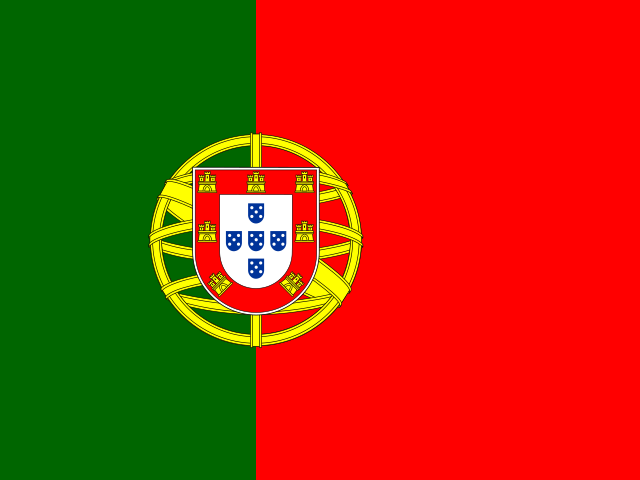 Portugal digital nomad visa
The clearest EU path from a nomad visa to permanent residence and citizenship.
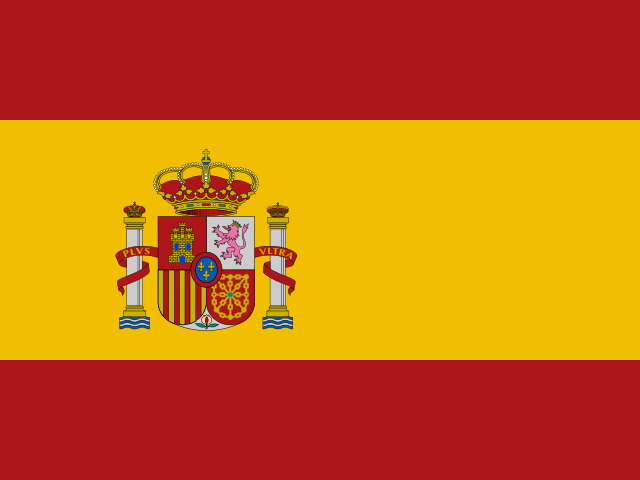 Spain digital nomad visa
A one-to-five-year route into a major EU country with an optional 24% flat-tax regime.
 Italy digital nomad visa
A national visa into Italy that renews locally and can pair with the impatriati 50% income-tax break.
 Greece digital nomad visa
A 12-month visa that converts to a two-year renewable permit, with a 50% income-tax scheme for new residents.
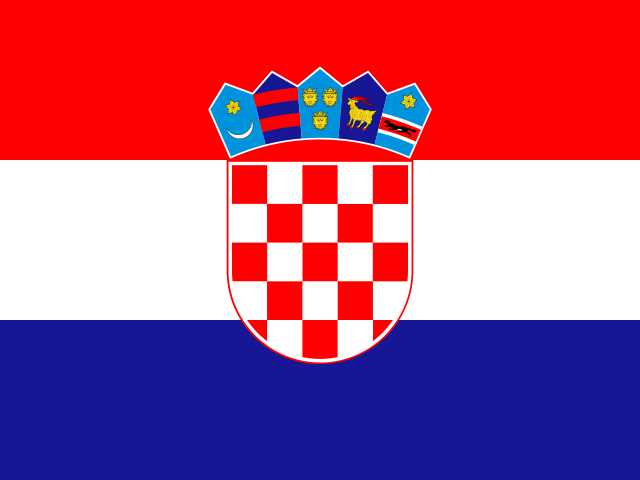 Croatia digital nomad visa
Foreign income is exempt from Croatian tax, with a stay now stretched to 18 months.
 Estonia digital nomad visa
The original digital nomad visa: a fast, fully vetted route into Schengen for high earners.
 Malta digital nomad visa
An EU island base with a flat 10% tax on your remote-work income after a 12-month tax holiday.
 Mexico digital nomad visa
A four-year, renewable route into Mexico that accepts either income or savings and leads to permanent residency.
FAQ
Which digital nomad visa is the fastest route to citizenship?
Does time on the Thailand DTV count toward permanent residency?
Do Caribbean nomad visas lead to citizenship?
Why doesn't Croatia's digital nomad time count?
Does the 2026 Portuguese law change affect nomads already there?
Can I switch from a dead-end nomad visa to one that counts?
Sources
Every income threshold, duration, fee, and rule on this page traces to an official government or consulate source. Last verified July 21, 2026.
- Spain Ministry of Foreign Affairs — Digital Nomad Visa (consular guidance) ↗
- EU Directive 2003/109/EC on long-term resident status (EUR-Lex) ↗
- Portugal Organic Law 1/2026 nationality reform (Sovereign Group summary) ↗
- Destination Thailand Visa (DTV) overview ↗
See our verification methodology and themaster source list.